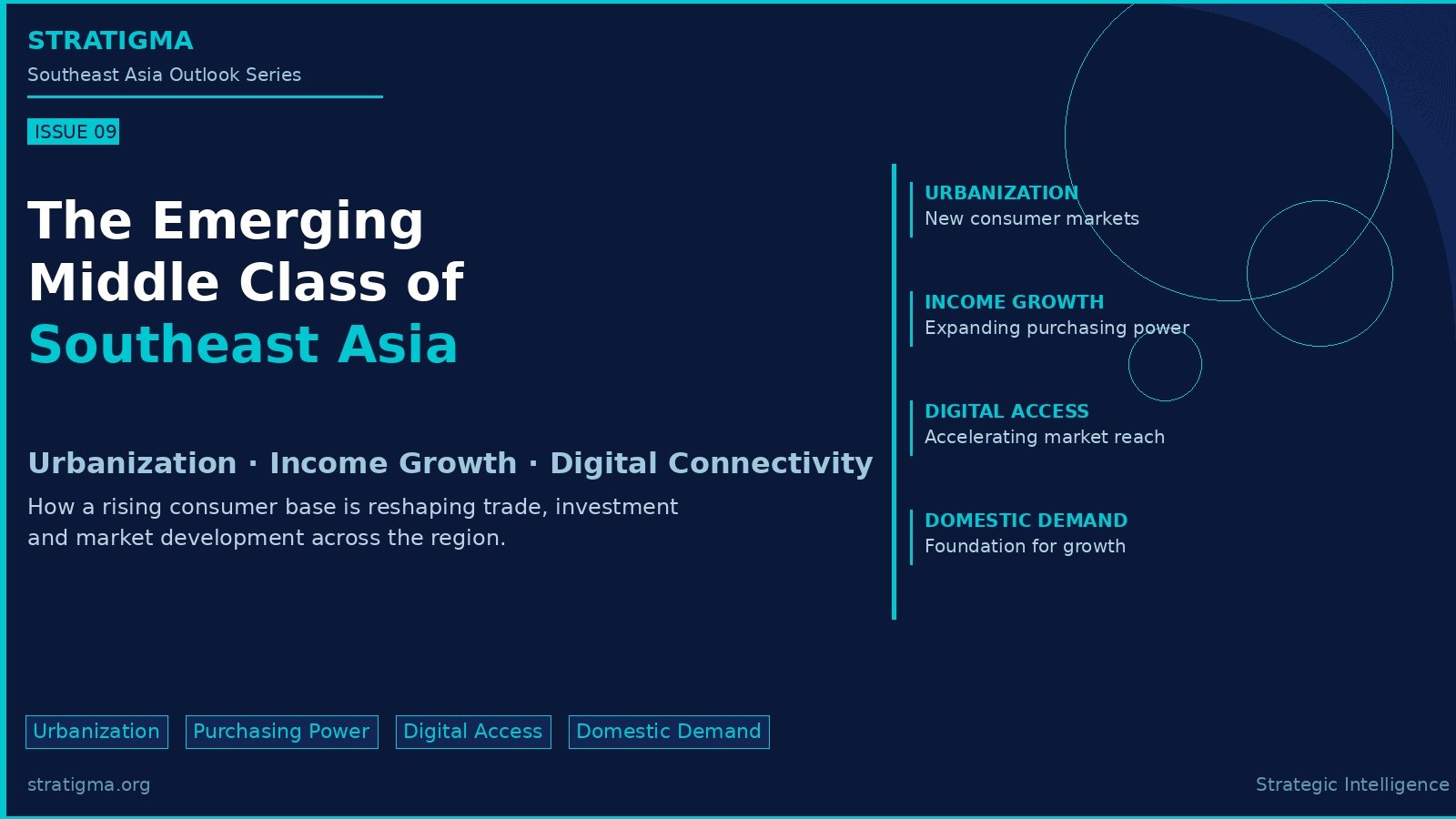
The Emerging Middle Class of Southeast Asia
How urbanization, income growth and digital connectivity are creating a new consumer base reshaping the region’s economic trajectory. A strategic briefing on the rise of domestic demand and its long-term implications for trade, investment and market development across Southeast Asia.
Context
Southeast Asia’s economic transformation is often discussed through the lens of manufacturing, trade and digital innovation. Yet one of the most powerful long-term drivers of growth lies in a quieter but equally important shift: the rise of a regional middle class.
Across the region, economic growth, urbanization and digital connectivity are gradually expanding household incomes and reshaping consumption patterns. While this transition is uneven across countries, the broader trend is clear.
Southeast Asia is evolving not only as a production hub, but as a major consumption region.
What’s Changing?
1) Urbanization Is Accelerating Across the Region
Major cities across Southeast Asia are expanding rapidly, attracting young populations seeking employment and education. Urban growth typically leads to:
- Rising household incomes
- Increased demand for services
- Expanding housing and transportation needs
- More structured consumption patterns
Urbanization is creating new consumer markets.
2) Income Growth Is Expanding Purchasing Power
As economies grow and labor markets develop, a growing segment of the population is moving toward stable incomes and regular consumption. This emerging middle class increasingly demands:
- Higher-quality goods and services
- Education and healthcare
- Financial products
- Leisure and entertainment
Consumption is becoming more diversified and predictable.
3) Digital Access Is Shaping Consumer Behavior
Smartphones and digital platforms are transforming how consumers interact with markets. Consumers are increasingly:
- Shopping online
- Using digital payments
- Comparing products and prices
- Accessing new services
Digital connectivity accelerates the expansion of consumer markets.
4) Domestic Demand Is Attracting Long-Term Investment
A growing consumer base provides stability and resilience. Domestic demand supports:
- Retail and e-commerce growth
- Service sector expansion
- Infrastructure investment
- Entrepreneurship and innovation
Consumption is becoming a key pillar of economic development.
Why It Matters
The emergence of a middle class changes the structure of economies.
Stronger consumer markets:
- Attract foreign investment
- Encourage business expansion
- Support job creation
- Reduce reliance on exports
Domestic demand provides a foundation for sustainable long-term growth.
Strategic Insight
Southeast Asia’s future will be shaped by the interaction between production, digitalization and consumption.
The rise of a regional middle class represents a structural shift that will influence trade, investment and market development for decades.
Understanding this transformation is essential for anyone following the region’s economic trajectory.