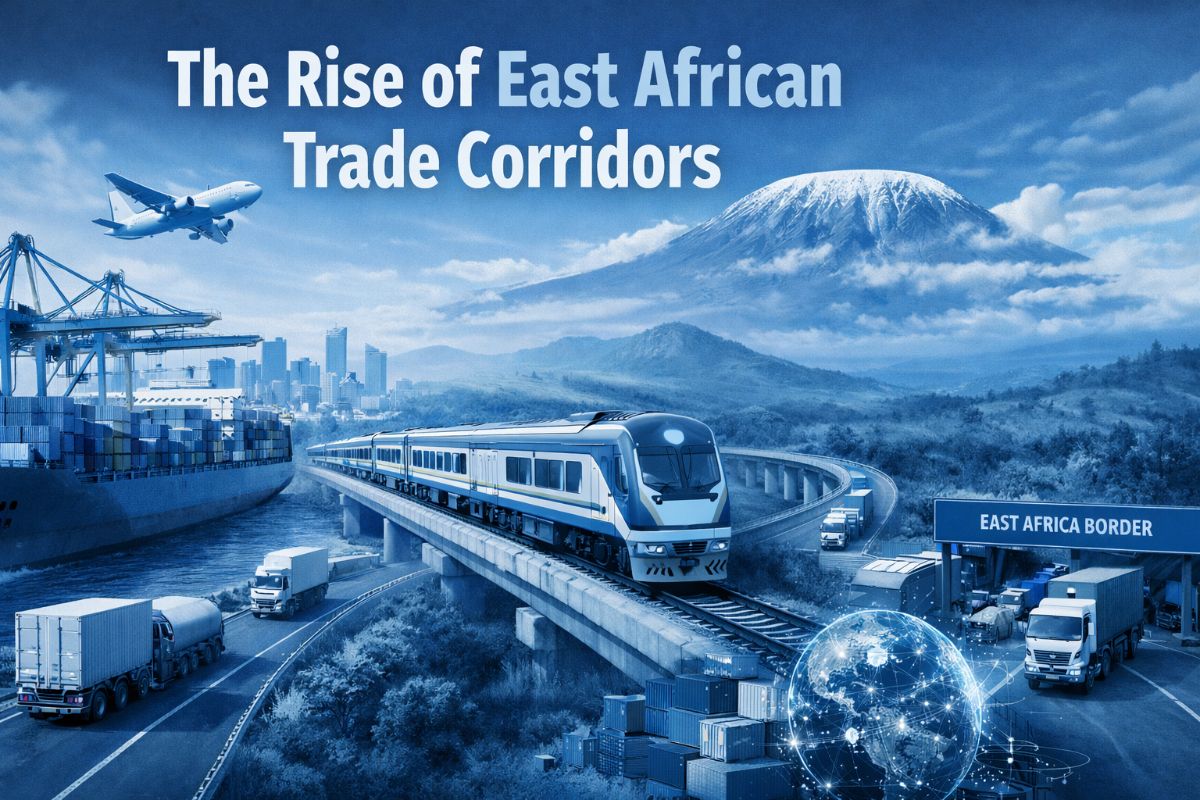
The Rise of East African Trade Corridors
How ports, railways and regional integration are reshaping the economic geography of East Africa. A strategic briefing on emerging trade corridors, logistics infrastructure and connectivity platforms across the East African region.
Context
Over the past decade, East Africa has quietly moved from the periphery of global trade discussions to the center of new connectivity maps. While global attention often focuses on major corridors such as the Suez Canal, the Belt and Road Initiative, or the India–Middle East–Europe corridor, a parallel transformation has been unfolding along the western rim of the Indian Ocean.
The East African region — stretching from Kenya and Tanzania to Rwanda, Uganda, Ethiopia and Malawi — is becoming a strategic gateway linking inland African markets to global supply chains.
This transformation is not driven by a single mega-project. It is the result of a network effect: ports, railways, highways, energy projects and regional trade agreements evolving simultaneously.
What’s Changing?
1) Ports Are Expanding Faster Than Trade Volumes
Dar es Salaam and Mombasa are no longer just national ports; they are positioning themselves as regional logistics hubs. Recent port modernization and expansion projects aim to serve landlocked countries such as:
- Rwanda
- Uganda
- Burundi
- Zambia
- Malawi
- Eastern Democratic Republic of Congo
These inland markets represent more than 250 million people.
The strategic value of East African ports lies in their hinterland reach, not their coastal economies.
2) Railways Are Reshaping Geography
Infrastructure investments are beginning to redraw the economic map of the region. Standard Gauge Railway (SGR) projects, dry ports, and cross-border highway upgrades are gradually reducing transport time and costs across the region.
Historically, moving goods from inland Africa to the coast could take weeks. Today, regional governments are competing to cut logistics timelines dramatically.
This shift is not only about efficiency; it is about integration.
3) Regional Integration Is Accelerating
The African Continental Free Trade Area (AfCFTA) is changing the strategic outlook of regional corridors. East Africa is uniquely positioned:
- Strong regional institutions
- Active cross-border trade
- Rapidly growing urban populations
Trade corridors are no longer built only for exports to global markets. They are increasingly designed to support intra-African trade. This marks a structural shift.
Why It Matters
Trade corridors do more than move goods. They reshape economic gravity.
East Africa’s corridors are beginning to connect three critical layers simultaneously:
1. Inland resource economies
2. Coastal logistics gateways
3. Global shipping routes
This convergence creates a multiplier effect:
- Faster market access
- Lower transaction costs
- Increased investment attractiveness
As transport reliability improves, investor perception changes. Markets once considered “remote” become reachable.
Strategic Insight
East Africa is not becoming a global manufacturing hub overnight. But it is becoming something equally important: a logistics and connectivity platform.
In the coming decade, the region’s competitive advantage will not be cheap labor or massive industrial zones. It will be its role as a bridge:
- Between landlocked Africa and the sea
- Between regional and global trade
- Between emerging markets and new supply chains
For policymakers, investors and trade institutions, the key question is no longer whether East Africa matters. The real question is: Which corridor will define the region’s economic future?