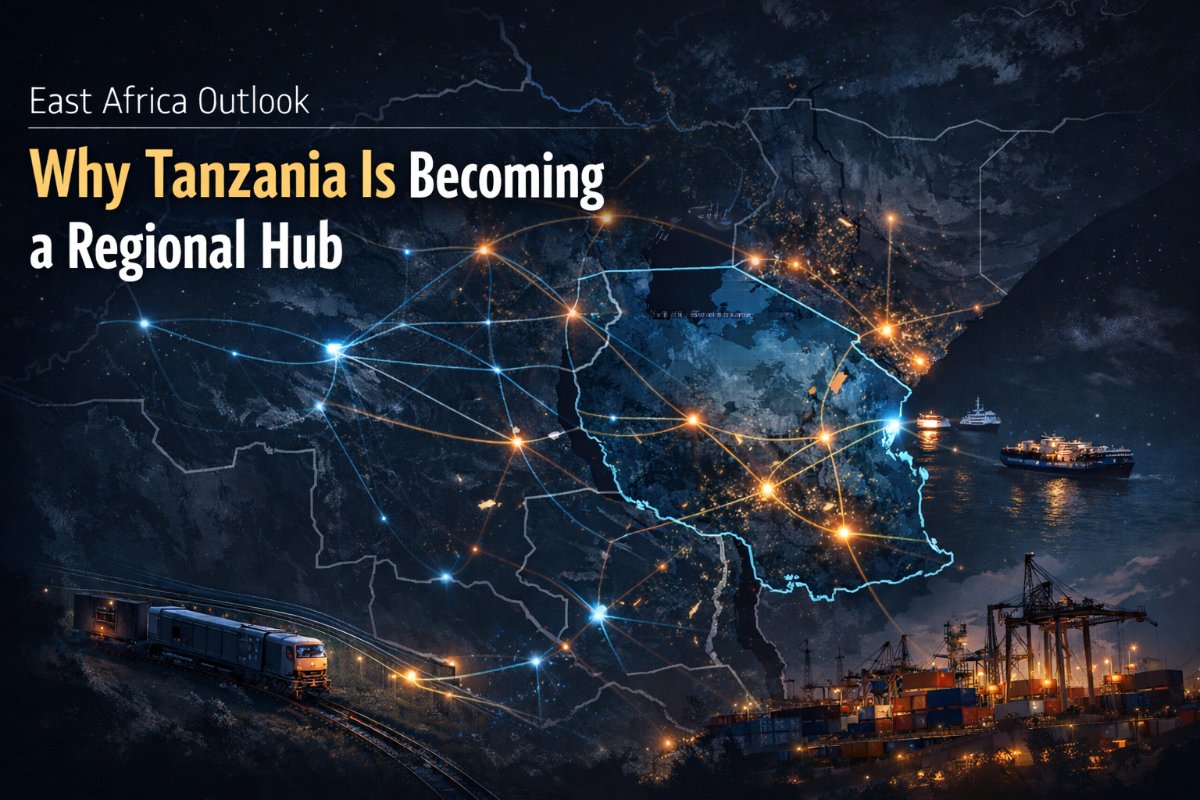
Why Tanzania Is Becoming a Regional Hub
How coordinated investments in ports, energy and connectivity are positioning Tanzania as East Africa’s strategic logistics axis. A strategic briefing on Tanzania’s transformation from peripheral economy to regional trade gateway.
Context
For decades, Kenya dominated the narrative of East Africa’s economic leadership. Nairobi emerged as the region’s financial and technology center, while Mombasa became its primary maritime gateway.
Yet over the past few years, a quiet shift has been underway.
Tanzania — once perceived as a slower-moving economy — is rapidly positioning itself as the region’s most strategic logistics and trade hub. This transformation is not based on a single reform or project. It is the result of coordinated investments in infrastructure, energy, ports, and regional connectivity.
The country is no longer operating in Kenya’s shadow; it is building an alternative regional axis.
What’s Changing?
1) The Transformation of the Port of Dar es Salaam
The modernization of the Port of Dar es Salaam is one of the most important developments in East African logistics. The port is being redesigned to:
- Increase cargo handling capacity
- Reduce vessel waiting times
- Improve regional transit efficiency
Dar es Salaam’s strategic value lies in its reach. It serves not only Tanzania but also several landlocked economies, including:
- Zambia
- Malawi
- Rwanda
- Burundi
- Eastern Democratic Republic of Congo
This hinterland access gives the port regional relevance far beyond national trade.
2) Tanzania Is Competing for Transit Trade
In East Africa, transit trade is a geopolitical asset. Landlocked countries must rely on coastal neighbors for access to global markets. This creates a strategic competition between ports and corridors.
Tanzania is positioning itself as a reliable alternative route to the Northern Corridor dominated by Kenya. By offering diversified logistics routes, the country is increasing its attractiveness for regional trade partners who seek to reduce dependency on a single gateway.
This diversification is strategically significant.
3) Energy Investments Are Changing the Industrial Outlook
Infrastructure alone cannot create a logistics hub. Reliable energy is equally critical. Recent investments in hydropower and natural gas projects are improving Tanzania’s electricity supply and reducing energy constraints that previously limited industrial growth.
A logistics hub without energy remains a transit point. A logistics hub with energy becomes an industrial platform.
Tanzania is moving toward the second scenario.
4) Political Stability as an Economic Asset
In emerging markets, predictability is often as valuable as infrastructure. Tanzania has increasingly emphasized:
- Regulatory continuity
- Investment-friendly reforms
- Regional cooperation
For investors evaluating East Africa, political stability is becoming a decisive factor in long-term planning.
Why It Matters
Regional hubs are not chosen; they are formed through accumulation of advantages.
Tanzania is gradually assembling three strategic pillars:
1. Port capacity
2. Energy supply
3. Regional connectivity
This combination positions the country as a gateway economy capable of serving inland markets across Southern and Central Africa.
The competition for regional leadership in East Africa is no longer a single-player narrative. It is becoming a multi-hub system.
Strategic Insight
East Africa’s future will likely be shaped by corridor competition, not corridor monopoly.
Tanzania’s rise reflects a broader trend: regional trade systems are moving away from single-point dependency toward diversified logistics networks.
In this evolving landscape, Tanzania’s role is becoming clearer.
Not as a challenger to existing hubs — but as a parallel axis reshaping the region’s economic geography.